In a music classroom in the Bass Music Center, students sit with their guitars, hands at the ready. If you were to ask them to play a standard G-major chord, many would hesitate. They are pianists, vocalists, percussionists and musical theater majors. In fact, perhaps no one in the room is a guitar major.
And yet, when they strum the open strings, the room doesn't fill with dissonant, chaotic clatter. Instead, it sounds a little like the music of legendary Canadian singer-songwriter Joni Mitchell.
鈥淚f you play all the strings at once in standard tuning, it just sounds like chaos,鈥� said Matthew Jones, the musicology professor at the helm of this unique course. 鈥淏ut Joni retunes the instrument. She makes the instrument match what her body can do.鈥�
Mitchell's experience of childhood polio in the 1950s opened the door to a lifetime of adaptive music making. And thanks to a determined student and a forward-thinking professor, students in the Wanda L. Bass School of Music are ensuring that Mitchell's music will be heard and performed by a new generation.
To understand the premise of Jones鈥� class, one must reconcile two things. First, this is not a typical music appreciation elective. It is an upper-level musicology seminar that uses Mitchell鈥檚 career to bridge the gap between high-level academic theory and musical performance.
Second, you have to understand the mechanics of the guitar 鈥� or rather, the mechanics of Mitchell鈥檚 hands.
Playing guitar in standard tuning requires dexterity. The player has to contort their left hand into a variety of shapes and positions to form chords. For a player with full dexterity, this is a rite of passage. For Mitchell, it was an obstacle. Mitchell contracted polio at age 9. While she recovered, the disease left her with weakness in both hands, forearms, and her back and chronic nerve pain, a condition called post-polio syndrome, all of which make playing the guitar challenging.
鈥淗er hands are not particularly dexterous,鈥� Jones explained. 鈥淪o she retunes the guitar.鈥�
In Jones鈥檚 class, students learn to twist the tuning pegs until the open strings sing a specific chord without the left hand touching the fretboard at all. This is known as "open tuning."
鈥淪o instead of having to do all this crazy stuff with your fingers, if I want a different chord, all I have to do is press down all six strings at one fret,鈥� Jones said. 鈥淰ery easily, now, I have a whole bunch of stuff that I can do, but I only have to move my hand up and down the guitar. You don't have to maneuver the fingers very much.鈥�
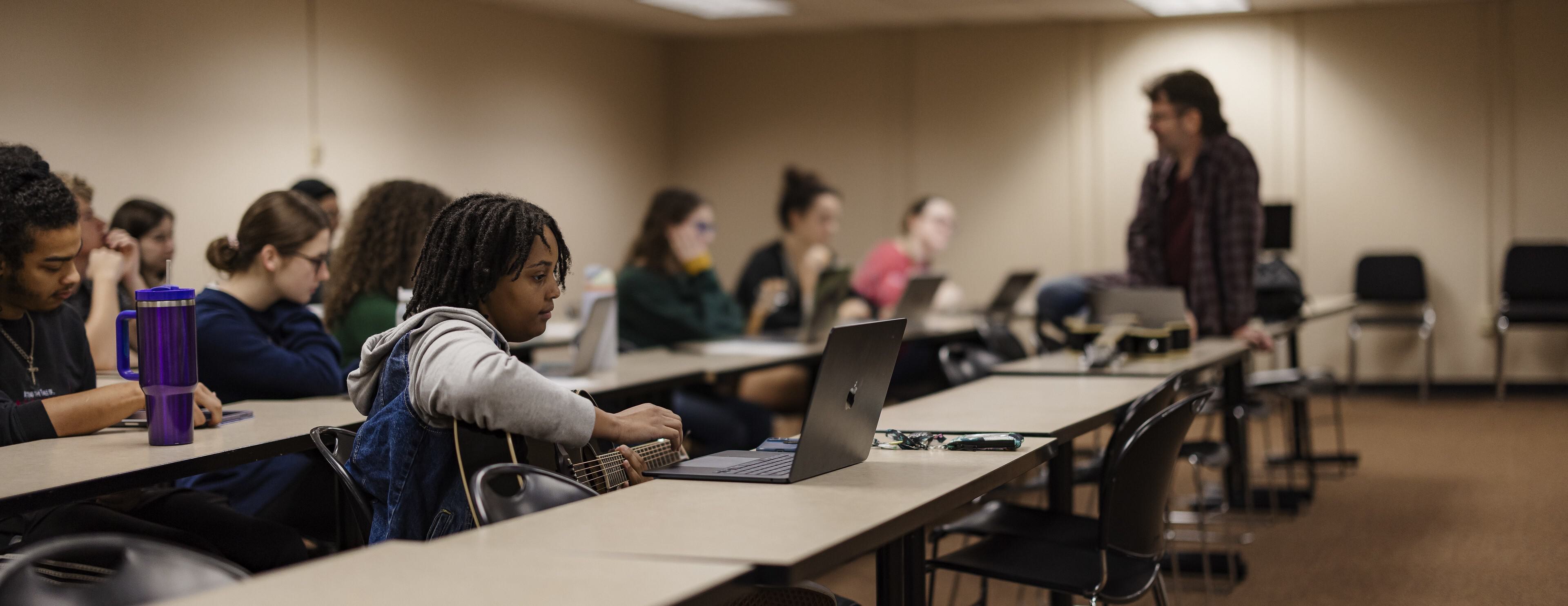
For the students, this method is a revelation. It levels the playing field. A vocalist who has never touched a fretboard can suddenly produce the rich, atmospheric soundscapes that define albums like 鈥淏lue鈥� or 鈥淗ejira.鈥�
鈥淭he point of entry in terms of guitar skill is quite low,鈥� Jones said. 鈥淏eginners can learn how to play a song in one of these open tunings in a few weeks. It sounds like you're doing something way fancier than you are.鈥�
Campaigning for class
Enrollment for the 2025 fall semester class quickly filled with a roster of 20 students, but the existence of the class was far from guaranteed. In fact, it almost didn't happen at all.
Lianna Paglia, a senior musical theater major, remembered seeing the course catalog last year and realizing the class wasn't listed. Having heard about the pilot version of the course that had run previously with only four students, she was determined to get in.
鈥淚 really wanted to push for the class, so I emailed (the dean),鈥� Paglia said. 鈥淗e said it probably wouldn鈥檛 happen this semester.鈥�
Undeterred, Paglia turned into an advocate. She began gathering names of other interested students, compiling testimonials, and proving to the administration that the demand was real. She worked for months, collaborating with Dr. Jones to put the pieces together.
鈥淚 kind of stepped away from it for a little bit, and then Dr. Jones sent me an email and was like, 鈥榃ait, there might be a chance... send me that list of students again,鈥欌�� Paglia recalled. 鈥淚 got some more testimonials, put it all together, and after a few months it was finally figured out.鈥�
The administration listened. When registration opened, the class was instantly popular.
鈥淓veryone in the class is really engaged with the material and feels comfortable speaking,鈥� Paglia said. 鈥淚t really does feel like a group of people who are all interested in the music.鈥�
Making theory tactile
Jones is a musicologist and historian whose academic work often intersects with gender and disability studies. He has spent years researching how bodily differences 鈥� whether from birth, accident or age 鈥� shape the way musicians interact with their art.
鈥淚t鈥檚 a response to (Mitchell鈥檚) disability, which is what is interesting to me about it,鈥� Jones said. 鈥淪he tunes the strings down, and the range of notes the instrument can play is considerably broader. You can actually play notes in these tunings that are impossible to do when the guitar is tuned in its standard way.鈥�
The structure of the course is designed to mirror this complexity. It isn't just about learning chords. It's about understanding the artist as a composer, not as a diarist, Paglia noted.
鈥淭here's a big emphasis on the fact that I think a lot of people take Joni Mitchell as, 鈥極h, she鈥檚 lived this whole life, and her songs are so personal,鈥欌�� Paglia said. 鈥淏ut we talk a lot about how she views herself as a composer. Her songs are more like plays. She calls them 鈥榗hords of inquiry.鈥� They're not standard to everyday pop music.鈥�
Paglia admits this required a mental shift.
鈥淚 remember writing in our first homework assignment, 鈥業 want to know the real-life events that have informed her songs,鈥欌�� Paglia said. 鈥淎nd I quickly learned that this is a viewpoint that she doesn't take very kindly to. She really wants people to see themselves in her music, and not try to analyze who the song is about.鈥�
To facilitate this deep dive, Jones developed a weekly rhythm designed to frame the learning process. The week begins on Monday with context on where the album fits in history. Wednesday is for the scholars, engaging with academic writing.
And then comes Friday: "Song in Focus Days."
鈥淓very Friday is a day where they bring their instruments, or sometimes we go downstairs to the piano lab,鈥� Jones said.
For the students, these sessions are where the theory becomes tactile. Paglia describes the class learning "Cactus Tree" from Mitchell's debut album, or heading to the piano lab to deconstruct the holiday classic "River."
鈥淣ot only do we learn it, but we talk about how it was composed,鈥� Paglia said. 鈥淲hat are key elements of Joni music that you can see repeated in this?鈥�
To keep the students processing the heavy influx of information, Jones assigns weekly "Joni Journals," short, 175-word reflections due every Friday.
鈥淭hey're really manageable. Dr. Jones does a really great job of facilitating discussion,鈥� Paglia said. 鈥淚t doesn't feel domineering at all. We really feel like we can voice our opinion, and he emphasizes there are no wrong answers.鈥�
From Tragedy to Breakthrough
For Paglia, the physical aspect of the class hit close to home. A guitarist since childhood, she had drifted away from the instrument during the isolation of the COVID-19 pandemic. Then, the summer before her senior year, she broke her foot.
鈥淚 was booked in a summer contract, but I had to drop because I couldn't dance,鈥� she said. 鈥淪o I was at home, and all I was doing was reading and playing guitar.鈥�
Coming into the class, she found that Mitchell鈥檚 adaptive techniques weren't just a historical curiosity. They were a practical tool.
鈥淚 have small hands, so these alternative tunings that allow for easier hand positions have allowed me to explore more difficult repertoire on my own. It鈥檚 totally reignited my love for guitar,鈥� Paglia said.
This is the core of Jones's teaching philosophy: reframing disability not as a tragedy to be overcome, but as a variance that can lead to artistic breakthrough.
鈥淚t鈥檚 about how people who inhabit different kinds of bodily difference, how they have changed things to make music meet their body where their body is, rather than just saying, 鈥榃ell, I can't do this the conventional way, so I can't do it at all,鈥欌�� Jones said.
Paglia notes that Jones鈥檚 expertise in disability studies adds a layer of depth that goes beyond standard music theory.
鈥淗e knows a lot about disability in the music field, so he's able to provide a really unique perspective on that issue as well,鈥� she said.
The Cabaret
The culmination of the semester is a project that perfectly encapsulates the course鈥檚 ethos of adaptation. Jones calls it the "Joni Mitchell In-Class Cabaret."
Students are tasked with selecting a song to perform. However, because the class is filled with a diverse array of instrumentalists 鈥� marimba players, percussionists, string players 鈥� they are encouraged to adapt Mitchell鈥檚 music to their own 鈥渘ative鈥� instruments, just as Mitchell adapted the guitar to her hands.
鈥淚鈥檝e tried to unleash their creativity and their musicianship in whatever way they feel like would serve them the best,鈥� Jones said.
Paglia chose 鈥淟ittle Green,鈥� a touching ballad from the 鈥淏lue鈥� album. True to the spirit of the class, she performed it on guitar, utilizing the specific open tuning Mitchell used to write it.
鈥淵ou almost have to (use the tuning),鈥� Paglia said. 鈥淭hat鈥檚 how you get the sound.鈥�
Other students took their own unique swings. Senior percussion major Nathan Rainey arranged Mitchell鈥檚 鈥淏oth Sides Now鈥� for marimba quintet. Music education major Alaina Brady-Hummingbird arranged 鈥淏ad Dreams Are Good鈥� for string ensemble, piano and voice. Student instrumentalists who were not enrolled in the class showed up to perform these arrangements during the cabaret.
As the semester wound down, the impact of the class extended beyond the credit hours. For students like Paglia, who balances the demands of directing shows, auditioning for summer stock and finishing her senior year, the class was a sanctuary of focused creativity.
鈥淚鈥檓 someone who really likes structure,鈥� Paglia said. 鈥淚t鈥檚 been really nice to have guitar be part of our final for the class. It鈥檚 probably one of the best and most engaging classes I鈥檝e had.鈥�
The students in Jones鈥� class are no longer just analyzing a text, they are practitioners of a unique tradition. They have learned that if the standard way doesn鈥檛 work, you don't quit 鈥� you twist the pegs, you change the tension and you find a new resonance.
Jones has created more than just a fan club for a folk icon. He has built a laboratory for musical empathy and adaptation. In teaching his students how Joni Mitchell retuned her guitar to survive, he is teaching them how to retune their own thinking to thrive.
鈥淚鈥檓 really excited to see what they come up with,鈥� Jones said.
