
On the surface, the subjects seem worlds apart: The abstract realm of mathematical topology and the intense physical arena of mixed martial arts.
Yet for OCU math professor Marquis Armwood, these two disciplines are two sides of the same coin, both fundamentally rooted in problem-solving and a profound understanding of structure, change and the search for invariants 鈥� the constants that persist despite transformation.
For Armwood, building connections between his experience as a mixed martial arts coach and his role as a college math instructor is all about ensuring both his fighters and his students are prepared for any twist or turn life throws their way.
Armwood鈥檚 journey from a young athlete who was forced to mature quickly after a basketball injury, to a college math major coaching fighters at a mixed martial arts (MMA) gym in North Dakota, and now as a university professor is a testament to the power of a disciplined 鈥渉abit of mind.鈥�
Armwood was born in New Jersey and moved to Georgia during high school on the promise of a Hope scholarship so he could better focus on his education. He lived with his aunt, an engineering chief at the U.S. General Services Administration in downtown Atlanta, and uncle, who served in the military. He said his mother, a schoolteacher, provided a solid foundation, and his aunt gave him a boost in confidence and motivation.
He enjoyed math, even though it wasn鈥檛 his strongest subject. At the age of 15 he even tutored his cousin, surprising himself that he enjoyed teaching the subject. But a 鈥渞ude awakening鈥� from SAT and ACT test results necessitated a rethinking of his study habits. More on that later.
Armwood鈥檚 interest in martial arts began around 2015 as a necessary balancing force to his academic pursuits when he was a graduate student at North Dakota State University. As a natural athlete, he was looking for a way to focus more on his physical health to improve his overall well-being. The sport was exploding in popularity at the time, and a classmate encouraged him to check out a nearby training facility in Fargo.
The martial arts bug bit hard. He liked it so much that he started coaching it as a side gig. Besides the obvious health aspects (鈥淚 can鈥檛 get that kind of a workout anywhere else,鈥� Armwood said), he has managed to apply what he鈥檚 learned on the mat to what he鈥檚 learned in the classroom, and vice versa.
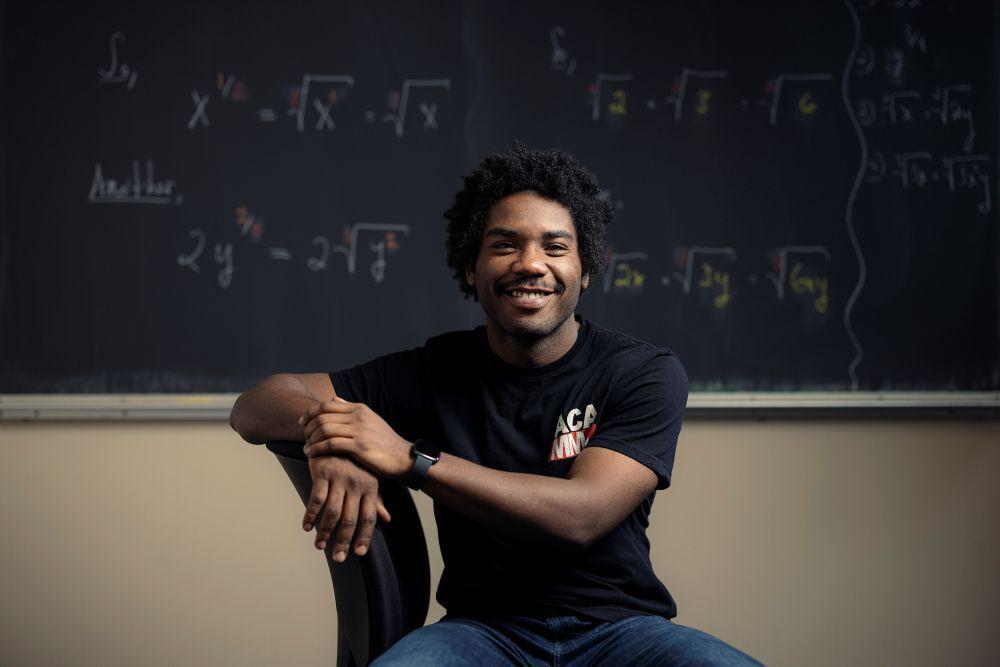
鈥淚t鈥檚 a counterintuitive kind of thing,鈥� he quipped, noting the traditional assumption is that mathematicians gravitate to other disciplines like music. But for him, 鈥渕artial arts has a problem-solving aspect to it as well.鈥�
As a coach at an MMA gym, he faced the chaos of the cage and the randomness of four-ounce gloves. The problem was how to protect his fighters and minimize damage. No matter how much you plan, 鈥渋t鈥檚 always random, because you can鈥檛 know the opponent鈥檚 next move,鈥� he said.
The core challenge is the same in math: how to find order and predict outcomes in a dynamic, unpredictable environment. This mirrors his specialty, topology, which he explains as the study of a shape鈥檚 properties that remain unchanged even when the shape is stretched, twisted or bent like clay. For example, a sphere and a coffee cup are topologically the same because one can be transformed into the other without tearing a hole or creating a new one. The number of holes is the invariant.
Armwood uses this focus on invariants to approach the seemingly infinite variety of problems. The goal in both the cage and the classroom is to narrow down the possibilities and work from the 鈥渂are bones鈥� structure, whether that structure is the number of holes in a space or the fundamental defensive techniques that will hold true against any attack.
A system for success
Armwood attributes part of his success to establishing a rigorous 鈥渉abit of mind,鈥� a process for problem-solving that transcends any single subject. When he struggled at math in high school, he realized he lacked a system for learning. The pivotal moment came when his engineer aunt advised him to simply write things down.
鈥淭his is about habits of mind,鈥� Armwood said. His teaching philosophy, influenced by educational theorists like Siegfried Engelmann, focuses on fostering core thinking sequences rather than simply memorizing concepts. He believes the true purpose of a calculus class is not just to learn the derivative, but to trigger the critical thinking sequence that transforms a student into a problem solver.
His teaching style resonates with students. Denzel Kidzeru, an accounting major in Armwood鈥檚 algebra class, has grown to appreciate Armwood鈥檚 approach.
鈥淗e has an easy-going style of teaching,鈥� Kidzeru said, describing the class structure that opens with an enlightening introduction to new concepts while connecting 鈥渙ld ideas with new ones.鈥� From there, students work on problems, with Armwood providing guidance and ideas on how to continue solving them.
Kidzeru has enjoyed the class so much that he decided to make math his minor.
鈥淲e all scrambled to sign up for his class next semester,鈥� Kidzeru said of his fellow classmates. 鈥淚 met my advisor and told her I need to take this class. I said, 鈥楶lease make sure I have this class.鈥欌��
Kidzeru pointed to Armstrong鈥檚 teaching approach, where he ensures everyone understands the early concepts before moving on to the next.
鈥淗e takes it from the basics,鈥� Kidzeru said, noting that Armwood goes out of way his to ensure everyone is prepared for tests. 鈥淗e has a class of people with a lot of knowledge of math and those who have little, and he makes sure that everyone is on the same page.鈥�
No matter what career fields his students aspire to, they appreciate their professor鈥檚 systematic, universal approach. Armwood uses his passion for martial arts to inform his teaching. Both disciplines require him to take an overwhelming amount of information 鈥� the dynamics of a fight or the properties of a space 鈥� and distill it down to the principles that cannot be changed.
When asked about how it makes him feel to hear how much his students enjoy his classes, Armwood said, 鈥淚t means everything to me.鈥�
鈥淚'm hoping to encourage them to just keep going, because that's literally what happened at every stage of my life,鈥� he said. 鈥淚 met a collective of people that motivated me to just keep going. They didn't care that maybe my path was going to be different than theirs, or that maybe I would exceed what they did.
鈥淚鈥檓 that way now. I'm OK if they turn out better than me. I'm OK with that. I just hope they acknowledge the fact that I was somewhere along their journey."
